On September 24, 2026, Texas Global and International Student and Scholar Services (ISSS), in partnership with Campus Events and Entertainment (E+E) and its student-led Films & Media Committee, presented a special screening of the blockbuster sci-fi film “Project Hail Mary.”
“Project Hail Mary” is a 2026 film based on the novel of the same name by Andy Weir, who also wrote the bestseller “The Martian.” The film stars Ryan Gosling as Ryland Grace, a middle school science teacher turned astronaut on an international space mission to find out what is dimming the sun and save humanity in the process. He travels to the Tau Ceti star system, where he forms an unlikely partnership with an extraterrestrial.
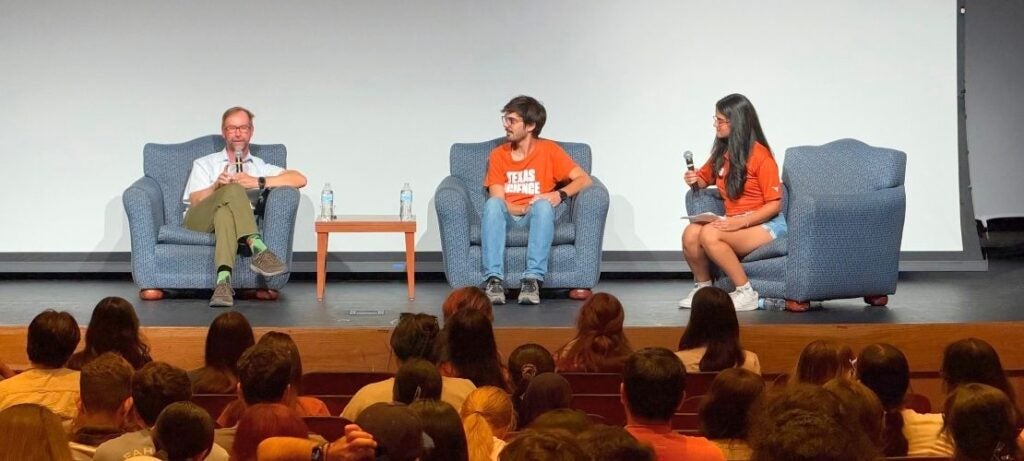
Before the film, ISSS and E+E hosted a panel with two international scholars affiliated with UT Austin’s Department of Astronomy: Dr. Michael Endl, whose research focuses on planets beyond our solar system, and Dr. Jaume Orell-Miquel, a postdoctoral scholar who also studies exoplanets. UT student Risha Kulkarni moderated the panel and asked the panelists about the connections between their research and the science depicted in the film.
According to the panelists, not all the science depicted in the film was grounded in reality, but some of it was. For example, Tau Ceti is, in fact, a real star system. In the film, the protagonist is an expert in “speculative extraterrestrial biology.” Kulkarni asked the panelists whether this is a real-world field. According to Dr. Endl, “It’s a funny title, but it’s a real science: astrobiology. They don’t actually study extraterrestrial life, but they study the potential for extraterrestrial life and the possibilities.”
Both panelists emphasized that one thing “Project Hail Mary” accurately depicted was the collaborative, international nature of scientific research, especially in the field of astronomy. “It’s a really collaborative effort,” said Orell-Miquel, noting that the collaboration happens not only locally but globally. Astronomy conferences are held all over the world, and as he put it, “we need a lot of people to build and use [large telescopes].” He went on to mention the Giant Magellan Telescope (GMT), under construction in Chile, which, when completed, will be up to 200 times more powerful than today’s most powerful telescopes. UT Austin is a founding partner in the GMT project.
Both panelists also described their own passion for science fiction, which they said can spark students’ interest in studying science. Dr. Endl discussed various ways that he uses science fiction in his teaching. He said movies are great teaching tools, and he recently used “Project Hail Mary” to teach students about relativity.
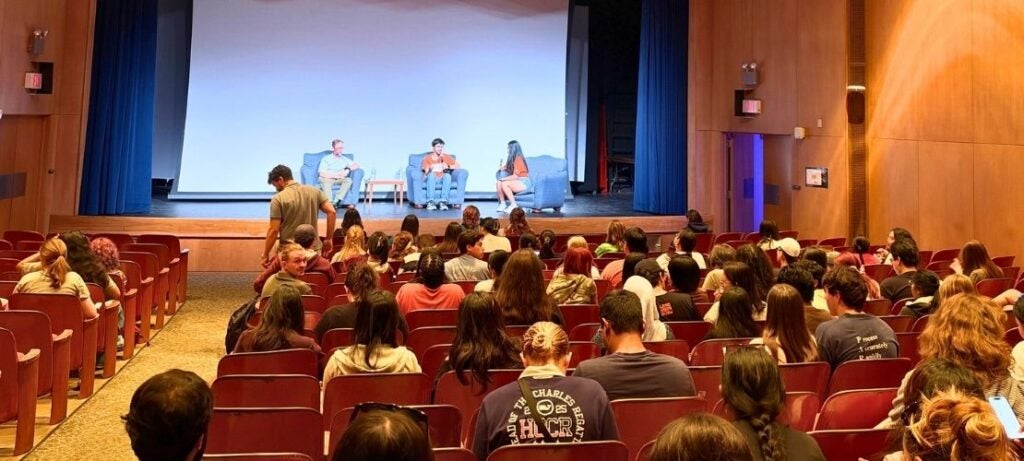
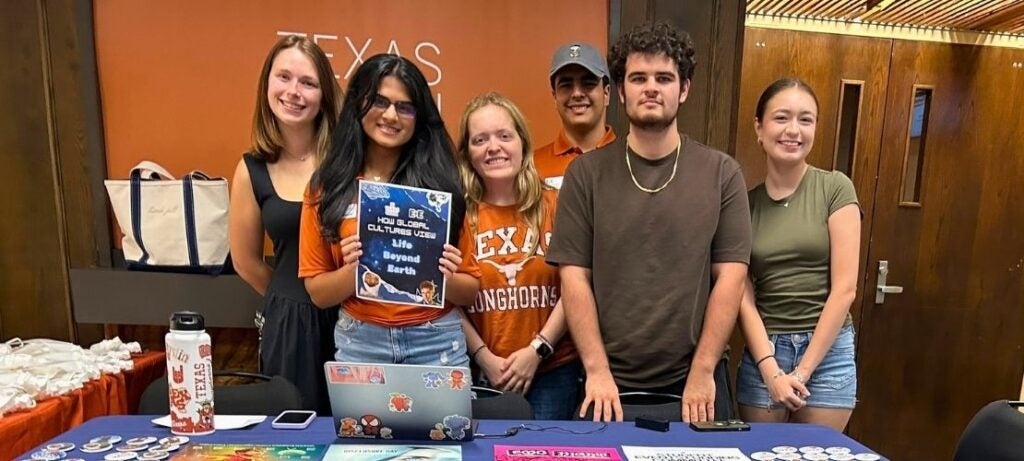
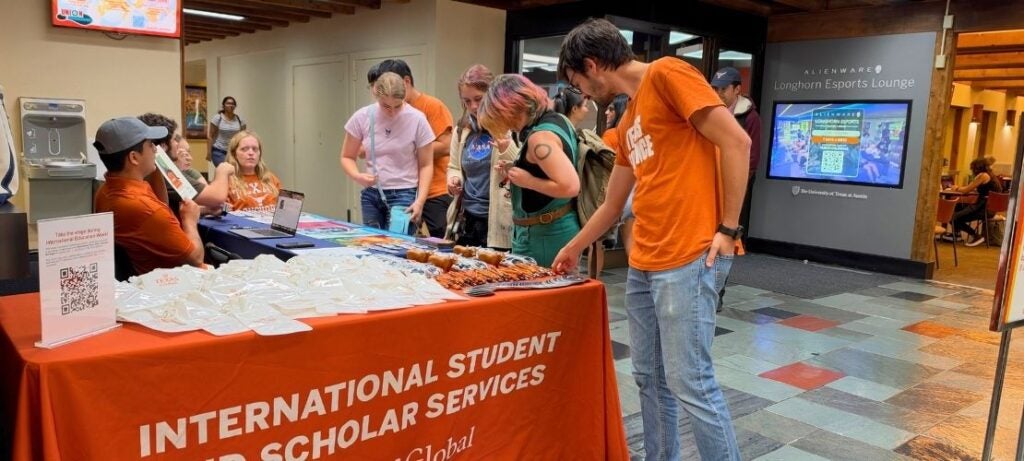
The “Project Hail Mary” screening and panel were held at the Texas Union Theater, where Texas Global and ISSS provided complimentary lemonade and popcorn, along with Texas Global swag. The Campus E+E team also provided giveaways, including posters and custom pins depicting various pop culture representations of extraterrestrials.
Events like this one reflect ISSS’s commitment to creating welcoming spaces where international students and scholars can share their expertise and connect with the wider campus community. This event was the second recent collaboration between ISSS and the Campus E+E team, and both groups look forward to co-hosting more film-related events in the future. To learn about upcoming ISSS and E+E joint programming, follow ISSS on Instagram.
Emily Spurgeon, senior program coordinator on the Intercultural Programs and Initiatives team at ISSS, contributed to this blog post.